When even walking across the living room to pour a glass of water leaves you gasping for breath, life can feel increasingly restricted. For families across Noida caring for elderly parents with Chronic Obstructive Pulmonary Disease (COPD), chronic bronchitis, or emphysema, breathlessness is an exhausting daily battle.
What often happens is a vicious cycle: walking feels breathless, so you move less. As you move less, your leg and heart muscles weaken. And as muscles weaken, even smaller activities require more oxygen, making breathlessness worse.
Pulmonary rehabilitation is the clinically proven way to break that cycle. While physical therapy doesn’t reverse structural lung damage, it dramatically improves the way your respiratory muscles work and teaches your body to do more with less effort.
Why Does COPD Make Breathing So Hard?
In healthy lungs, airways bounce back open like elastic bands during exhalation. In COPD, airways lose elasticity and can collapse, trapping stale air inside the lungs (hyperinflation). Your lungs stay partially full, which flattens your diaphragm—your primary breathing muscle.
To compensate, your body starts using small “accessory” muscles in your neck and upper chest to haul air in. Those little muscles tire out fast, leading to that tight, panicked sensation in your chest.
3 Breathing Techniques That Relieve Breathlessness Fast
1. Pursed-Lip Breathing (The Calming Anchor)
This is the single most valuable breathing technique for anyone with COPD. Pursed-lip breathing creates gentle backpressure in your airways, preventing them from collapsing so trapped air can escape:
- Inhale slowly through your nose for 2 counts, letting your belly expand.
- Pucker your lips as if you were about to blow out a candle or whistle.
- Exhale slowly and smoothly through your pursed lips for a count of 4.
- Do not force the air out. Just let it glide out. Your exhale should always be twice as long as your inhale.
2. Diaphragmatic (Belly) Breathing
Sit back comfortably in an armchair or lie on your bed with knees supported by a pillow:
- Place one hand flat on your upper chest and your other hand on your belly below your ribs.
- Breathe in slowly through your nose: your belly hand should push outward, while your chest hand stays almost still.
- Breathe out through pursed lips, feeling your belly sink gently inward.
- Practice for 5 minutes, twice daily. This retrains your diaphragm to do its rightful job.
3. The “Huff” Technique for Clearing Phlegm
Repeated, violent coughing fits can exhaust a senior with COPD and collapse airway passages. The Huff cough is far gentler and more effective:
- Sit upright and take a slow, deep breath in through your nose.
- Hold your breath for 2 seconds.
- Open your mouth and breathe out forcefully, as if fogging up a mirror, saying: “Huh! Huh!”
- Follow with one gentle cough into a tissue to clear the loosened secretions.
Safe, Monitored Movement at Home
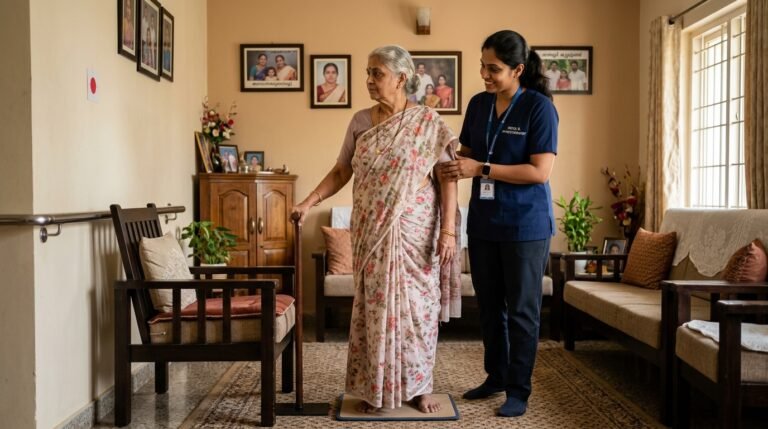
During an in-home pulmonary physiotherapy session, exercises are carefully paced and monitored with a digital pulse oximeter to ensure oxygen saturation stays safe:
- Paced Hallway Walking: Inhale for two steps, exhale through pursed lips for four steps.
- Seated Arm Lifts: Lifting lightweight balls or bands while coordinating your breath (breathe out on the effort).
- Sit-to-Stand Drills: Strengthening quadriceps so standing up from chairs takes less oxygen.
Signs of a COPD Flare-Up (Exacerbation)
Contact your pulmonologist immediately if you notice:
- Sputum changes from clear to dark yellow, green, or brown, or significantly increases in volume.
- Oxygen levels drop consistently below your normal target (e.g. below 88-90%).
- Swelling develops in the feet, ankles, or lower legs.
- Unusual morning confusion or severe headaches, which can indicate carbon dioxide buildup.
Frequently Asked Questions
Is it safe to exercise if my parent is on supplemental oxygen?
Yes, absolutely! In fact, using their prescribed oxygen during exercise allows their muscles to strengthen without putting excessive strain on their heart. Your physiotherapist ensures the oxygen flow rate matches doctor guidelines.
Why is home physiotherapy ideal for COPD patients in Noida?
Seasonal dust, smog, and changing weather along the expressway can trigger severe coughing and bronchospasms. Receiving care in an indoor, air-purified home environment keeps patients protected and comfortable.
Can pulmonary exercises reduce hospital readmissions?
Clinical studies consistently show that patients who practice regular pulmonary rehabilitation have significantly fewer emergency room visits and hospital readmissions compared to those who remain inactive.
This article provides general information and does not replace individual medical advice, professional assessment or emergency care.