Bringing a new baby home is magical, but let’s be honest about what nobody talks about enough: the physical toll pregnancy and delivery take on a mother’s body. Between sleepless nights, nursing posture, and carrying a growing infant, your body is working in overdrive.
Social media often pushes the toxic pressure to “bounce back” within weeks. You see videos encouraging new mothers to jump into heavy planks, crunches, or HIIT workouts. But here’s the medical reality: doing traditional crunches or planks too early after delivery can actually worsen abdominal separation and stress a healing pelvic floor.
Postpartum recovery isn’t about fitting into old jeans overnight. It’s about restoring the deep structural foundation of your core and pelvic floor so you can pick up your baby, run, and live without lower back pain or accidental leaks.
What Is Diastasis Recti Really?
During pregnancy, as your baby grows, your abdominal wall has to expand. The linea alba—the band of connective tissue running down the middle of your stomach between your left and right rectus abdominis muscles—stretches and softens under pregnancy hormones.
When this tissue remains stretched apart after delivery, leaving a gap wider than two finger-widths that domes or bulges when you sit up, that’s Diastasis Recti Abdominis (DRA). Healing it isn’t just about closing the gap; it’s about rebuilding tension across that connective tissue so your core can handle real-world pressure.
The 4 Foundational Rebuilding Exercises
These gentle exercises can usually begin within a few weeks postpartum (once cleared by your obstetrician) and require nothing more than a quiet floor mat while your baby naps:
1. The Connection Breath (Synchronizing Pelvic Floor & Diaphragm)
Your diaphragm at the top and your pelvic floor at the bottom work like a coordinated piston:
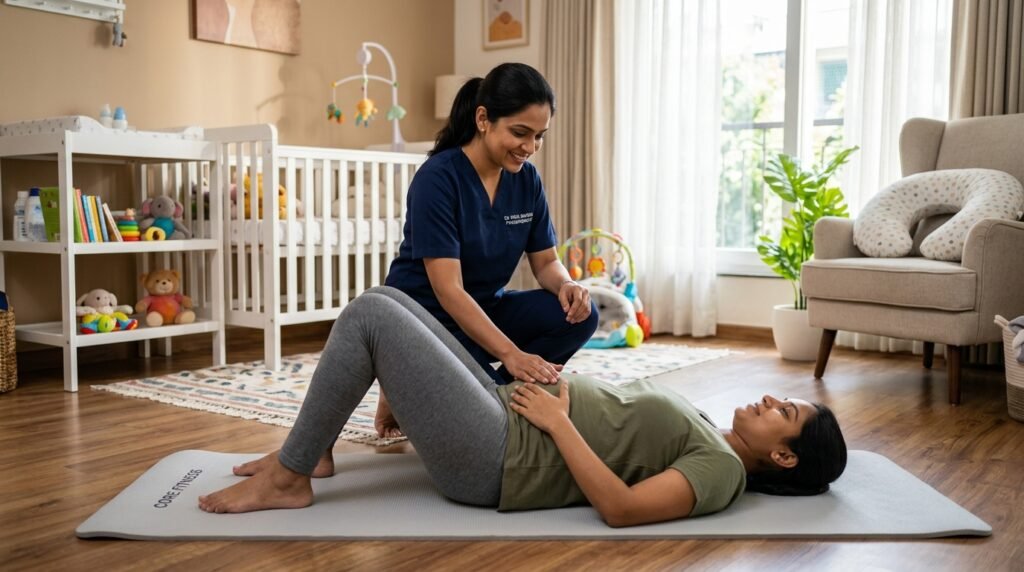
- Lie on your back with knees bent and feet flat on the floor. Place your hands on your lower ribs.
- Inhale gently through your nose, feeling your ribs expand wide and your pelvic floor naturally relax.
- As you exhale slowly through soft lips, gently lift your pelvic floor muscles upward (like gently holding in urine) while drawing your lower belly in.
- Do 10 slow, calm breath cycles. Never squeeze aggressively or hold your breath.
2. The Transversus Abdominis (TVA) Draw-In
Your transversus abdominis muscle wraps around your midsection like your body’s natural corset:
- In the same position, place your fingertips just inside your front hip bones.
- Breathe out, and gently imagine pulling your two hip bones toward each other.
- You should feel a subtle, firm tightening beneath your fingers without your pelvis tilting or back arching. Hold for 5 seconds, repeat 10 times.
3. Supported Glute Bridges
Place a small cushion or rolled towel between your knees. Breathe in. As you exhale, gently squeeze the cushion, engage your pelvic floor, and lift your hips toward the ceiling until your thighs and torso form a straight line. Squeeze your glutes at the top for 3 seconds, then lower down slowly. Do 10 reps.
4. Heel Slides with Neutral Pelvis
Lie on your back with knees bent. Engage your deep core gently on an exhale and slowly slide your right heel along the mat until your leg is almost straight. Inhale as you slide it back in, and switch legs. Keep your hips and lower back rock-steady.
3 Exercises to Avoid in the First 12 Weeks
- Traditional Crunches and Sit-Ups: They increase pressure inside your abdomen, pushing the abdominal contents forward against the weakened linea alba.
- Full Planks on Toes: Gravity pulls your internal organs downward against an unsupported belly wall, encouraging doming.
- High-Impact Jumping and Running: Sends repetitive downward shockwaves onto a healing pelvic floor.
Frequently Asked Questions
When can I start home postpartum physiotherapy?
Gentle pelvic floor breathing and posture checks can start as early as 2 to 3 weeks after an uncomplicated vaginal delivery. For C-section deliveries, we typically begin gentle recovery around 4 to 6 weeks with your doctor’s approval, focusing on gentle scar tissue mobility.
Is it too late to heal diastasis recti if my baby is already a year old?
Not at all! Muscle and connective tissue retain the ability to remodel and strengthen years after childbirth. We frequently help mothers whose children are toddlers or older rebuild strong cores and eliminate lingering lower back pain.
Why choose in-home postpartum physiotherapy?
Packing diaper bags, managing feeding schedules, and traveling across Noida with a newborn to visit a clinic is exhausting. Having an empathetic female physiotherapist come directly to your living room allows you to heal comfortably in privacy.
This article provides general information and does not replace individual medical advice, professional assessment or emergency care.