Picking up a coffee mug shouldn’t make you wince in pain. Neither should typing an email, opening a tight door handle, or wringing out a wet cloth. But if you have that sharp, persistent ache right on the outer bump of your elbow, you’re experiencing tennis elbow.
Here’s the funny thing: over 90% of people with lateral epicondylitis have never picked up a tennis racket in their lives. The people we treat across Noida are software engineers, writers, graphic designers, home cooks, and people doing repetitive manual tasks with their hands.
For decades, people were told: “It’s tendon inflammation—just ice it and rest.” But modern sports medicine has completely overturned that idea. Tennis elbow is not an acute inflammation (“itis”); it is a degenerative tendinopathy (“osis”). The tendon has developed tiny micro-tears and failed to heal properly because it lacks direct blood flow.
And here is the critical takeaway: resting a damaged tendon does not make it stronger. Progressive, loaded exercise does.
The Gold Standard: Eccentric Strengthening
Eccentric exercise means making the muscle and tendon lengthen while working under load. Clinical trials prove that slow eccentric loading stimulates collagen production, realigns tendon fibers, and drives healing deep into the tissue.
1. Eccentric Wrist Extensions with a Light Weight
Sit at a table. Rest your forearm flat on the surface with your wrist hanging over the edge, palm facing down. Hold a 0.5 kg or 1 kg dumbbell (or even a small 500ml water bottle):
- Use your healthy hand to lift the weight up into wrist extension.
- Let go with your healthy hand.
- Using only your painful arm, slowly lower the weight back down toward the floor over a count of 4 to 5 seconds.
- Lift it back up with your good hand and repeat for 10 to 12 repetitions, 2 sets daily.
2. The Tyler Twist (Using a Flexible Rubber Bar)
If you have access to a flexible resistance bar (like a TheraBand FlexBar), this exercise is remarkably effective. Grasp the bottom of the bar with your painful hand. Twist the top of the bar with your healthy hand. Bring both arms out straight in front of you, and slowly let your affected wrist untwist against the bar’s resistance. Perform 3 sets of 10 daily.
3. Forearm Pronation and Supination
Hold a lightweight hammer or water bottle by its base. Keeping your elbow tucked against your side at 90 degrees, slowly rotate your forearm so your palm turns facing up toward the ceiling, then slowly rotate it facing down toward the floor. Do 15 controlled repetitions.
4. Targeted Forearm Extensor Stretch
Extend your affected arm straight out in front of you with elbow locked and palm facing down. Use your other hand to gently pull your fingers and wrist downward toward the floor. You’ll feel a pleasant stretch along the top of your forearm. Hold for 25 seconds, repeat 3 times.
3 Everyday Adjustments That Stop Elbow Flare-Ups
- Get an Ergonomic Vertical Mouse: Traditional flat mice force your forearm bones to cross over each other (pronation), keeping your extensor tendons under tension all day. A vertical mouse puts your hand in a neutral “handshake” position.
- Wear Your Counterforce Brace Correctly: Many people strap an elbow band directly over the painful bony bump. That’s wrong! Place the strap two finger-widths below the painful spot on the thickest part of your forearm muscle. This creates a secondary anchor point that relieves tension on the tendon origin.
- Lift Objects with Palms Facing Up: When picking up shopping bags, laptop bags, or small children, scoop your hands underneath with palms facing upward (using your biceps) rather than reaching with knuckles up.
Frequently Asked Questions
Should I get a steroid injection for tennis elbow?
Steroid injections often give fast pain relief for a few weeks, but long-term studies consistently show high recurrence rates and potential tendon weakening at 6 to 12 months. Progressive exercise and physiotherapy deliver far more permanent results.
How long does tennis elbow take to heal?
Tendons heal slowly because of limited blood supply. Most patients feel noticeable relief within 4 to 6 weeks of consistent eccentric exercises, with full recovery taking between 3 to 6 months.
Can a visiting physiotherapist help?
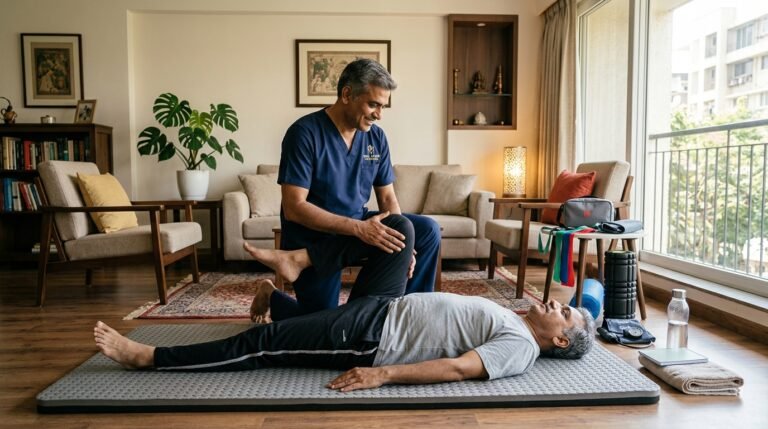
Yes. A visiting physiotherapist can provide manual soft tissue release, dry needling, and monitor your exercise loads so you don’t over-stress the tendon.
This article provides general information and does not replace individual medical advice, professional assessment or emergency care.