Tearing your Anterior Cruciate Ligament (ACL) is one of the most frustrating injuries an active person can experience. Whether it happened on the football turf, playing badminton, or simply from an awkward landing, having ACL reconstruction surgery is your pathway back.
However, orthopedic surgeons will tell you straight: the surgeon builds the graft, but your physiotherapy determines whether you ever run, jump, or play confidently again.
A reconstructed ACL goes through a biological process called ligamentization over several months. During the early weeks, your new graft is at its most vulnerable, which means rehabilitation must be disciplined, phased, and guided with precision.
The Number One Priority: Getting Your Knee Straight
Most patients worry endlessly about how far their knee can bend (flexion). But here’s the clinical truth: getting your knee completely straight (0 degrees of passive extension) in the first two weeks is vastly more important.
If you fail to regain full extension early on, you will develop a permanent limp that stresses your lower back and opposite hip for years.
- The Heel Prop: Sit on your sofa or bed with your leg straight out in front of you. Place a rolled bath towel directly under your ankle or heel so your knee hangs in mid-air. Relax and let gravity gently pull your knee down straight. Do this for 5 minutes, 3 times a day.
- Never Put Pillows Under Your Knee: Sleeping with a pillow directly under your bent knee feels comfortable, but it encourages a stiff bend (flexion contracture) that is incredibly painful to correct later. Always support the ankle instead.
Your Week-by-Week Home Roadmap
Weeks 1 to 2: Waking Up the Sleepy Quad
After knee surgery, your brain involuntarily shuts down nerve signals to the quadriceps muscle due to joint swelling. Your main job is waking that muscle back up:
- Quad Sets: Place a small washcloth under your knee. Squeeze your front thigh muscle hard, pushing the knee down and trying to slide your kneecap up toward your hip. Hold for 5 seconds. Do 15 reps, 3 times daily.
- Straight Leg Raises (SLR): Once your quad can lock the knee straight without sagging (zero quad lag), lift your whole leg 20 cm off the bed. Hold for 3 seconds, lower slowly.
- Patella Glides: Gently wiggle your kneecap up, down, and side to side with your fingers to keep scar tissue from binding it down.
Weeks 3 to 6: Moving Off Crutches & Building Control
As swelling subsides, your visiting physiotherapist will help you transition from two crutches down to one, and finally to unassisted walking:
- Mini Wall Squats: Stand with your back flat against a wall, feet shoulder-width apart. Slide down gently into a shallow 30-degree bend, pause for 3 seconds, and press back up through your heels.
- Stationary Cycle: Once your knee can bend to about 100 degrees, gentle rocking back and forth on a stationary exercise bike pumps fluid out of the joint and lubricates cartilage.
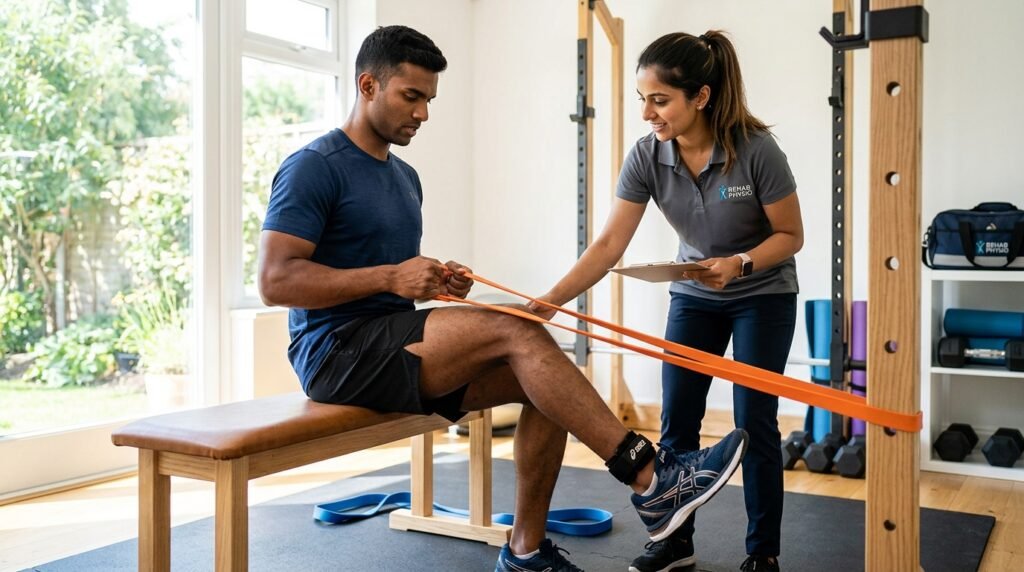
- Calf & Hamstring Activation: Light resistance band curls to balance the strength on both sides of the knee.
Weeks 7 to 12: Balance, Stability & Joint Awareness
When the ACL tears, the microscopic nerve sensors inside the ligament that tell your brain where your knee is in space (proprioception) are destroyed. You have to retrain that joint awareness:
- Single-Leg Stance: Practice balancing on your operated leg near a kitchen counter for 30 seconds. Once that feels easy, try it while tossing a tennis ball or with eyes closed.
- Controlled Step-Downs: Step down off a low 4-inch yoga block or step, keeping your knee tracking directly over your second toe without letting it wobble inward (valgus collapse).
- Resistance Band Walks: Monster walks and lateral band steps to strengthen your gluteus medius and protect knee alignment.
Frequently Asked Questions
When can I safely drive after right-knee ACL surgery?
For a right-knee reconstruction, you generally need 4 to 6 weeks until your emergency brake reaction time and quad power return to safe levels, and you must be completely off narcotic pain medications.
Why does my shin feel numb?
During surgery, a tiny sensory nerve branch near the front of your knee (the saphenous nerve) is stretched or cut. A patch of numbness the size of a coin on the outside of your shin is very common and usually shrinks over the first year.
When can I return to running and playing sports?
Recreational jogging usually starts around 3 to 4 months, but pivoting sports like football or basketball require 9 to 12 months and passing strict strength and hopping symmetry tests.
This article provides general information and does not replace individual medical advice, professional assessment or emergency care.