If you’ve ever felt that sudden, searing electric shock that starts in your lower back, shoots through your hip, and travels all the way down the back of your leg to your calf or foot, you don’t need anyone to tell you how miserable sciatica is.
Most people immediately panic, thinking: “My back is broken” or “I’m going to need spine surgery.”
Take a breath. Over 90% of disc herniations (technically called Prolapsed Intervertebral Disc, or PIVD) recover completely with conservative, guided physical therapy. Your body has an incredible natural ability to heal and resorb disc material over time, provided you stop putting excessive mechanical pressure on the irritated nerve.
What Is Actually Happening in Your Spine?
Think of your spinal discs like small jelly-filled cushions between each vertebra. When repetitive bending, heavy lifting, or poor sitting posture causes a tear in the tough outer ring, the inner gel can bulge out. If that bulge presses against the thick sciatic nerve root (usually between L4-L5 or L5-S1), it triggers radiating pain, numbness, or tingling down your leg.
In physiotherapy, our main goal is something called centralization. If your exercises make the calf and thigh pain retreat back up into your lower back, that’s a fantastic sign—even if the back itself temporarily feels a bit sore. It means pressure is coming off the nerve root.
3 Safe At-Home Decompression Moves
Always do these on a firm yoga mat or carpeted floor, never on a plush, sagging bed:
1. Prone Lying (The Belly Rest)
Lie face down with your arms relaxed at your sides and your head turned comfortably to one side. Just breathe slowly into your belly for 2 to 3 minutes. For many people with acute disc bulges, simply lying flat lets the abdominal muscles relax and takes the compressive load off the lower spine. If your leg pain eases, move to step 2.
2. Prone on Forearms (The Half Sphinx)
From the belly position, prop your upper body up on your elbows, keeping your hips and pelvis flat on the floor. Take slow, deep breaths and let your lower back sag naturally. Hold for 30 to 45 seconds. This gentle backward bend helps nudge the disc gel away from the nerve.
3. Sciatic Nerve Flossing
Sit upright on a sturdy chair with your hands resting on your lap. Slowly straighten your painful leg while tilting your head backward to look at the ceiling. Then, bend your knee back down while tucking your chin to your chest. Do this in one smooth, rhythmic motion 10 times. You’re gently sliding the sciatic nerve back and forth through surrounding tissues without straining it.
The 4 Biggest Mistakes People Make During an Acute Flare-Up
- Sinking into Deep Sofas: Soft couches force your lower back into continuous flexion, pushing the disc gel directly backward against the pinched nerve. Stick to upright dining chairs.
- Trying to Touch Your Toes: Stretching your hamstrings by bending forward pulls the sciatic nerve tight against the disc bulge like a guitar string, aggravating inflammation.
- Staying in Bed for Days: Prolonged bed rest weakens core support and makes joints stiffer. Short, gentle 5-minute walks every hour do wonders for circulation and spinal lubrication.
- Using Heat Instead of Ice Early On: In the first 48 hours of sharp nerve pain, apply an ice pack wrapped in a cloth to your lower back for 15 minutes. Ice calms nerve inflammation; heat can sometimes increase swelling in acute phases.
Red Flags: When to Go to the Hospital Immediately
While the vast majority of sciatica cases heal safely with home physiotherapy, seek emergency medical care if you experience:
- Sudden loss of bowel or bladder control (incontinence or being unable to pass urine).
- “Foot drop”—your foot drags when you walk and you can’t lift your toes off the floor.
- Numbness around your groin, inner thighs, or buttocks (saddle anesthesia).
Frequently Asked Questions
How long does it take for a slipped disc to heal?
Most patients experience noticeable relief within 3 to 6 weeks of targeted physical therapy, with the disc fragment naturally dehydrating and shrinking over 8 to 12 weeks.
Can walking help with sciatica?
Yes! Walking is one of the best natural therapies for sciatica because it pumps nutrients into spinal discs and stimulates blood flow. Keep your pace comfortable and take frequent short breaks rather than one long trek.
Why is home physical therapy better during severe sciatica?
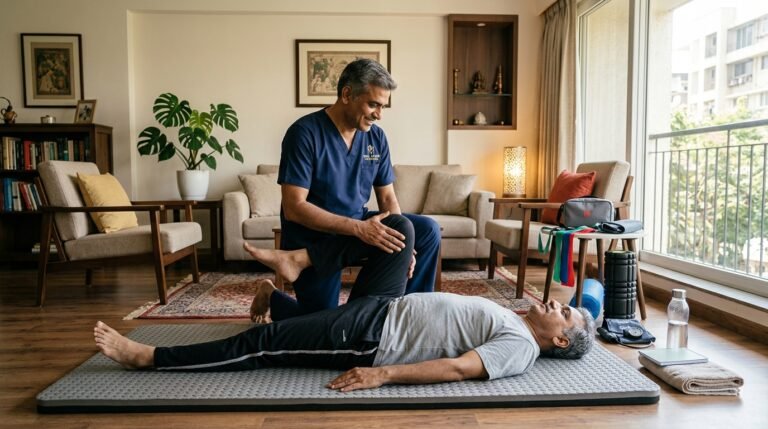
When every step or car bump sends sharp pain down your leg, traveling across Noida to a clinic is agony. Having an experienced physiotherapist evaluate you in your own bedroom ensures gentle, personalized care without the transit trauma.
This article provides general information and does not replace individual medical advice, professional assessment or emergency care.